

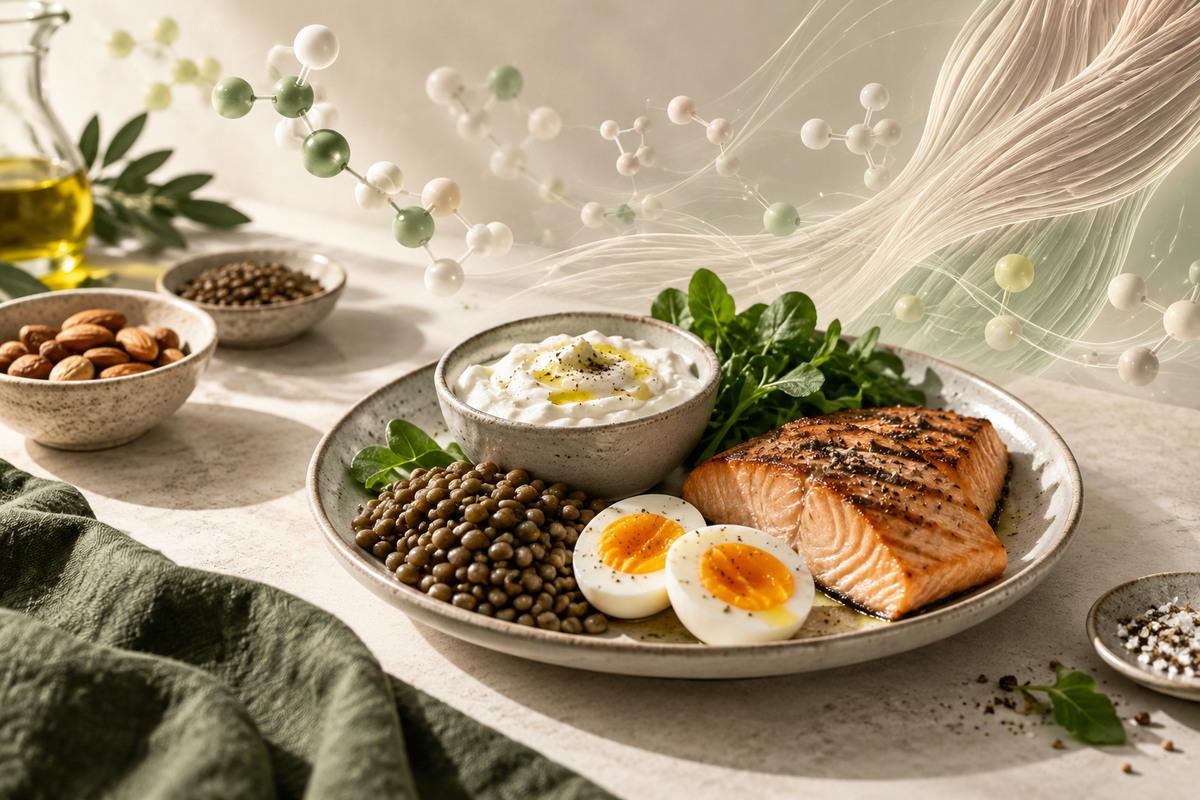
There is a persistent rule in fitness nutrition that your body can only “use” 20 or 30 grams of protein at a time. Eat more, the story goes, and the rest is wasted.
That idea came from a real scientific observation, but it was turned into a much broader rule than the evidence supports. Researchers often measure muscle protein synthesis over a few hours after a meal or workout. In those experiments, the muscle-building response can plateau at a certain dose. But a short-term plateau in one tissue is not the same thing as saying your body cannot use a larger meal.
The newer evidence gives a more useful answer: there is no single protein ceiling that applies to every meal, every person, and every training situation. The amount that meaningfully contributes to muscle protein synthesis depends on the exercise stimulus, the protein dose, the time window being measured, and what you are trying to optimize. Total daily intake still matters more than obsessing over a rigid per-meal cutoff.
Where the 20-gram number came from
One of the most influential dose-response studies was published in 2009. Six young men performed lower-body resistance exercise and then consumed 0, 5, 10, 20, or 40 grams of egg protein. In that specific setup, muscle protein synthesis rose with increasing protein and appeared to plateau at 20 grams. The 40-gram dose did not further increase the measured muscle protein synthesis response over the four-hour observation period, while leucine oxidation increased. That study is a major reason the 20-gram figure became so widely repeated.
But the experiment answered a narrow question: how much protein maximized the measured acute response after a particular lower-body workout in a small group of young men? It did not establish a universal maximum for all meals or show that amino acids beyond 20 grams have no biological use.
The “ceiling” moves when the workout changes
A later study changed the exercise stimulus. Resistance-trained men performed a whole-body workout and then consumed either 20 or 40 grams of whey protein. This time, 40 grams produced a roughly 20% greater muscle protein synthesis response than 20 grams.
That does not mean 40 grams is the new universal answer. It demonstrates why a fixed number is problematic. A larger amount of active muscle, a different exercise session, a different protein source, and a different measurement window can all change the response.
The 100-gram study changed the question again
In 2023, researchers used an intensive tracer protocol to compare 0, 25, and 100 grams of milk protein after resistance exercise in healthy young men. The 100-gram dose produced a larger and much more prolonged anabolic response—lasting more than 12 hours—than 25 grams. More dietary amino acids appeared in circulation and were incorporated into muscle protein, and whole-body protein net balance increased. Amino-acid oxidation rose only modestly relative to the much larger amount of protein consumed.
This is strong evidence against the simplistic idea that everything above 20 or 30 grams is automatically “wasted.” It is not, however, evidence that a 100-gram meal is the best way to build muscle over months. The study measured an acute post-exercise response, not long-term changes in muscle mass. A 2024 commentary on the study emphasized that distinction and noted that the participants were recreationally active young men rather than a broadly representative or highly trained population. The acute biology is important; the long-term prescription remains less certain.
Why spreading protein across the day can still make sense
If a large meal can produce a prolonged anabolic response, should you put most of your protein into one sitting? Probably not as a default.
In a small crossover feeding study, healthy adults ate the same total amount of protein in two different patterns. One pattern distributed about 30 grams across breakfast, lunch, and dinner; the other skewed most of the protein toward dinner. The more even pattern produced about 25% higher 24-hour muscle protein synthesis.
That is mechanistically compelling, but the longer-term evidence is less clean. A review of protein-distribution studies concluded that the evidence for an “optimal” distribution pattern on muscle-related outcomes is limited and inconsistent, and that the effects of protein quantity and protein distribution are difficult to separate. In other words, distribution may matter, but the evidence is much stronger for getting enough protein in the first place than for following a precise meal schedule.
Total daily protein still comes first
For people resistance training with the goal of adding or preserving muscle, the most useful anchor is still total daily intake. A large 2018 meta-analysis of 49 studies and 1,863 participants found that protein supplementation modestly improved gains in fat-free mass and strength during resistance training. In its meta-regression, additional fat-free-mass benefit did not continue to rise beyond an average total intake of about 1.62 grams per kilogram of body weight per day. That number is a population estimate, not a biological cliff or an individual prescription.
For individual meals, a sports-nutrition position stand has suggested roughly 0.25 grams per kilogram of high-quality protein—or about 20 to 40 grams—as a practical serving target, ideally repeated across the day. That is better understood as a useful starting range for physically active adults than as a hard upper limit.
A better rule than “30 grams max”
- Hit the daily target first. If total protein is chronically low, perfect meal distribution will not rescue it.
- Use 20–40 grams as a practical serving range, not a ceiling. Depending on the workout and context, a larger serving can produce additional or more prolonged anabolic effects.
- Spread protein when it is convenient. Three or four meaningful protein servings across the day is a simple way to create repeated opportunities for muscle protein synthesis without turning meal timing into a rigid rule.
- Do not fear a large meal. A dinner containing 50 or 60 grams of protein is not automatically wasted because it crossed an arbitrary threshold.
- Do not force enormous servings either. The fact that 100 grams can be used does not mean 100 grams at once is superior to a well-distributed day of eating for long-term muscle gain.
The bottom line
Your body does not switch off protein use after 20 or 30 grams. Those numbers emerged from acute muscle-protein-synthesis experiments and are useful for thinking about efficient servings, but they are not universal absorption limits.
The best-supported hierarchy is simpler: get enough protein across the day, resistance train consistently, and then distribute that protein across meals in a way that is practical. A meal with more than 30 or 40 grams is not wasted. A very large protein meal can produce a larger and longer anabolic response, but we do not yet have evidence that routinely concentrating huge doses into single meals is better for long-term muscle growth than meeting an adequate daily intake across several meals.
This Field Note is for general educational purposes and is not individualized medical or nutrition advice.
Sources and further reading
- Moore DR et al. Ingested protein dose response of muscle and albumin protein synthesis after resistance exercise in young men. Am J Clin Nutr. 2009.
- Macnaughton LS et al. The response of muscle protein synthesis following whole-body resistance exercise is greater following 40 g than 20 g of ingested whey protein. Physiol Rep. 2016.
- Trommelen J et al. The anabolic response to protein ingestion during recovery from exercise has no upper limit in magnitude and duration in vivo in humans. Cell Rep Med. 2023.
- Witard OC, Mettler S. The Anabolic Response to Protein Ingestion During Recovery From Exercise Has No Upper Limit in Magnitude and Duration In Vivo in Humans: A Commentary. Int J Sport Nutr Exerc Metab. 2024.
- Mamerow MM et al. Dietary protein distribution positively influences 24-h muscle protein synthesis in healthy adults. J Nutr. 2014.
- Hudson JL, Bergia RE III, Campbell WW. Protein Distribution and Muscle-Related Outcomes: Does the Evidence Support the Concept? Nutrients. 2020.
- Morton RW et al. A systematic review, meta-analysis and meta-regression of the effect of protein supplementation on resistance training-induced gains in muscle mass and strength in healthy adults. Br J Sports Med. 2018.
- Jäger R et al. International Society of Sports Nutrition Position Stand: protein and exercise. J Int Soc Sports Nutr. 2017.


Let's talk about it.
Have a question, perspective, or experience to share? We'd love to hear from you. Join the conversation and help us build a more informed wellness community.
No comments yet. Be the first to join the conversation.
Leave a comment.
Your voice matters. Share your thoughts with the Take Control Science community.